The only math book you need to understand AI!
Feodor Yevtushenko (b. ca. 2008; still in high school when this book was written): from California; attended University High School; repeated gold medals or world-first finishes at IPhO, IOAA, RMM, and other international contests. He reportedly turned down MIT's offer and later accepted. Public résumés often cast him as a top prodigy across physics, astronomy, and mathematics.
费奥多尔·叶夫图申科(Feodor Yevtushenko,约2008年生,写作本书时仍为高中生):来自加州,曾就读于 University High School;在国际物理奥林匹克(IPhO)、国际天文奥林匹克(IOAA)、罗马尼亚大师杯数学竞赛(RMM)等国际赛事中屡获金牌或世界第一。曾拒绝MIT录取后又接受。公开履历中常被视为跨物理、天文与数学的顶尖天才。
Learn by exploring
Your math-to-AI workspace
Unlock the interactive companion and Math4AI Studio with your purchase.
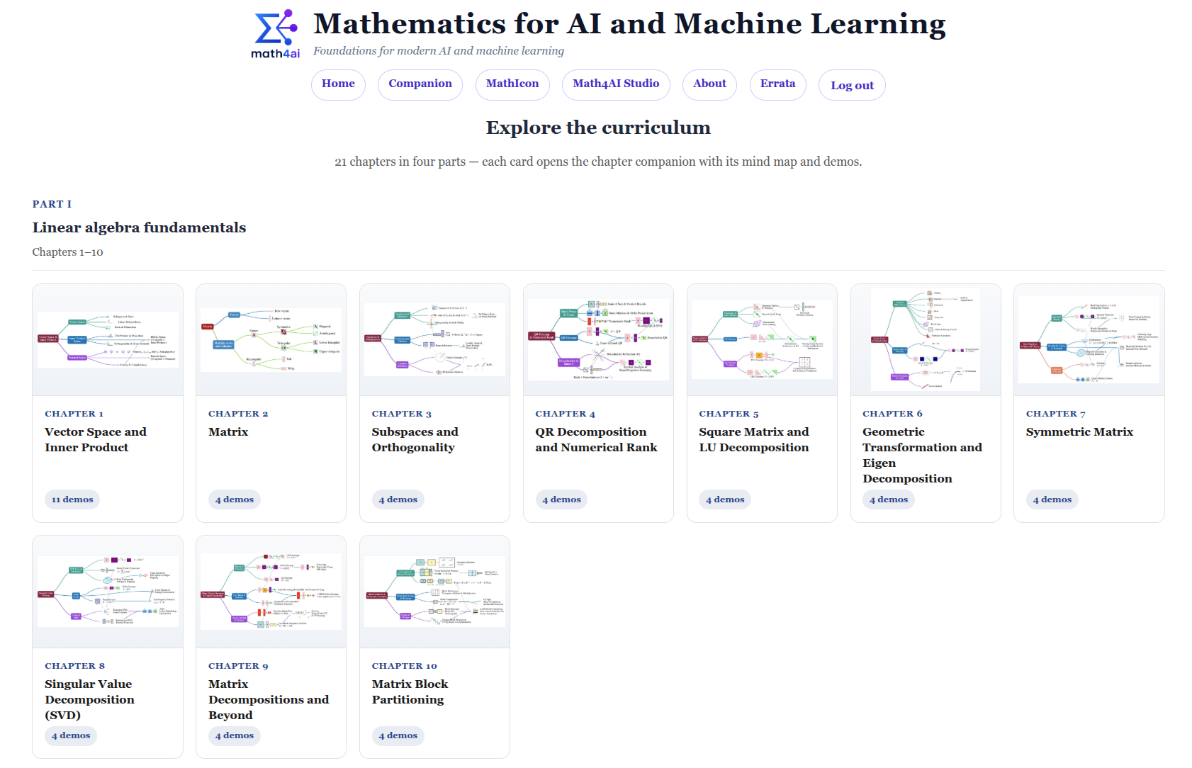 Explore the curriculum
Open chapter mind maps, demos, and interactive explanations.
Explore the curriculum
Open chapter mind maps, demos, and interactive explanations.
 Build in Math4AI Studio
Create visual canvases that connect mathematical ideas to AI.
Build in Math4AI Studio
Create visual canvases that connect mathematical ideas to AI.
A comprehensive, graduate-level textbook that provides the rigorous mathematical foundations essential for understanding modern artificial intelligence and machine learning systems.
The book spans 21 chapters organized into four parts.
Part I (Chapters 1–10)
Linear algebra fundamentals: vector spaces, inner products, matrix operations, subspaces, orthogonality, QR decomposition, LU factorization, eigendecomposition, symmetric matrices, and the Singular Value Decomposition (SVD)—establishing the mathematical foundation for representation in AI.
Part II (Chapters 11–12)
Differentiation and optimization: matrix calculus with gradients and Hessians, and optimization methods including gradient descent and its variants—formalizing learning as structured search in parameter space.
Part III (Chapters 13–16)
Probability and information theory: probability and random variables, entropy and KL divergence, the Evidence Lower Bound (ELBO), variational inference and latent variable models, and Bellman equations for reinforcement learning—shifting the perspective from fitting functions to modeling distributions.
Part IV (Chapters 17–21)
Score functions, dynamics, and diffusion: score functions and energy-based models, Langevin dynamics and sampling methods, stochastic differential equations with Itô calculus, ODE/SDE continuous limits of algorithms, and Fokker-Planck equations governing distribution dynamics—framing generative modeling as the study of distributional dynamics.
What distinguishes this textbook is its seamless integration of mathematical rigor with practical AI/ML applications. Each concept is motivated by real-world problems in machine learning, deep learning, large language models, graph neural networks, reinforcement learning, and modern generative frameworks. The full-color figures illuminate complex ideas, while extensive exercises reinforce understanding.
Designed for graduate students, researchers, and experienced practitioners, this book serves as both a learning resource and a comprehensive reference. Whether you're building foundation models, researching novel architectures, or seeking deeper understanding of the mathematics powering AI systems, this textbook provides the essential theoretical toolkit.